
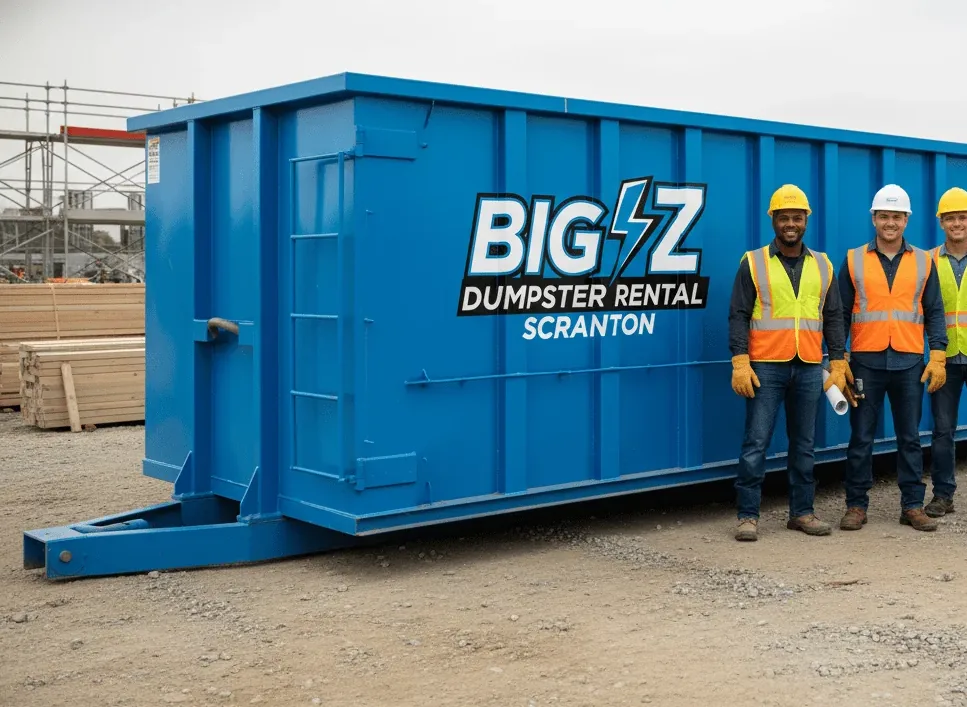
Heavy debris
Concrete & Heavy Debris Dumpsters in Scranton, PA
Concrete, coal-era brick, stone foundation and flagstone all go in a small can loaded to a fill line. We tell you the limit before delivery, not after.
Heavy debris is the one category where bigger is flat-out wrong. Concrete, coal-era brick, cinder block, stone foundation, slate and flagstone are dense enough that a 10 yard container loaded to a marked fill line is already a legal truckload. Order a 30 yard for a patio tear-out and you will end up with a container you are not allowed to fill, which helps nobody.
Scranton gives us more of this work than most cities its size. Stone foundations under nearly every pre-war house, brick from the coal era in walks and chimneys, flagstone porches and steps all over the Hill Section and Green Ridge, and driveways that freeze-thaw takes apart every winter until somebody finally rips them out. Add old coal ash and cinder fill in yards and basement floors and you have a lot of dense material moving.
The move that saves you real money is a clean load. Concrete on its own, brick and block on their own, kept free of wood, trash, rebar mesh and dirt, is a recyclable material rather than landfill waste. Mix it and it all goes to disposal as one heavy mess. Tell us what you are tearing out when you call and we will spec the can and the fill line. Also see demolition debris for mixed loads.
Dense material we haul in NEPA
Driveway removal
Freeze-thaw destroys concrete drives here on a schedule. Broken slab, base gravel and the odd chunk of asphalt, loaded to a fill line in a small can.
Sidewalk and step replacement
City sidewalk slabs and the concrete or stone steps in front of every row home. Short jobs, deceptively heavy loads, usually one 10 yard container.
Stone foundation repair
Repointing or partial rebuild on a pre-war foundation. Old stone and mortar are as dense as anything we handle, so the fill line comes well below the rails.
Coal-era brick and chimney
Local brick from the anthracite years, plus mortar. Clean brick can often be recycled if you keep wood, flashing and roofing out of the container.
Flagstone and slate
Porches, walks and roofs across the older neighborhoods. Slate roofing in particular is far heavier than asphalt shingle and needs to be sized as masonry, not roofing.
Patio and retaining walls
Pavers, block, wall stone and the base material under them. Hillside lots in East Mountain and the West Side produce more of this than flat ground does.
Cinder block and coal ash
Block foundations and the ash and cinder fill left under basement floors and yards by old coal furnaces. Dense, dusty and heavier than it looks.
Dirt, sod and soil
Excavation spoil and stripped sod from grading and drainage work. Wet dirt after a NEPA rain week can weigh double what the same load weighed dry.
Why a 10 yard is the right can
Every heavy load gets a fill line, and we mark it before we leave. A 10 yard filled part way to that line is the standard answer for concrete, brick, block, stone and dirt, because trucks and roads have weight limits that have nothing to do with how much space is left in the box. A 15 yard occasionally makes sense for lighter mixed masonry or when the material is spread across a long job and you need the extra footprint. What never works is a 30 yard for dense material. If you have a large tear-out, we run multiple pulls of a small can rather than one load nobody can move.
10 Yard Dumpster
Concrete, brick, block, dirt, tile and small heavy-debris jobs.
View this size →15yd³15 Yard Dumpster
Single-room remodels, roof tear-offs up to about 20 squares, garage cleanouts.
View this size →Placement on soft ground and winter
A loaded heavy-debris container puts serious weight on a small footprint, which is exactly how driveways get cracked. Protection boards go under the rails on every drop, and we will walk the placement with you if the drive is older concrete, blacktop that has been softening all summer, or pavers. On steep Hill Section and East Mountain grades we look for a level set before anything else. In winter, frozen ground actually helps, but ice, snowbanks and plough routes do not, so keep the approach clear. No off-street parking means a street placement and a City of Scranton permit; more on that in the driveway protection guide.
Not sure this is the right service? Describe the job on the phone and we will point you at the right container even if it is a different service page. Call (570) 774-4910.
Get a flat quote
Two minutes on the phone gets you a size, a price and a delivery slot. No forms.
(570) 774-4910Recommended sizes
Related services
How it works
Concrete & Heavy Debris in four steps
- 1
Call us
Tell us the project, your address and when you want it. Two minutes on the phone and you have a flat price.
- 2
We deliver
Our driver walks the drop, lays protection boards and sets the container exactly where you want it.
- 3
You load it
Take your time within your rental window. Keep it level with the top rail and we handle the rest.
- 4
We haul it
Call or text when you are done. We pull it, sort what can be recovered and dispose of the rest properly.
Concrete & Heavy Debris FAQs
How much concrete fits in a 10 yard dumpster?
Less than the box holds, which is the whole point. Concrete is dense enough that a 10 yard container reaches a safe, legal haul weight well before it reaches the top rail, so we mark a fill line at delivery and you load to it. As a rough gauge, think a few inches of broken slab across the floor, not a container filled to the brim.
Can I mix concrete with regular debris?
You can, but it costs you. A clean load of concrete, brick or block with no wood, trash, dirt or roofing in it is recyclable material and is handled differently from mixed waste. Throw a few bags of household junk on top and the whole container becomes mixed heavy debris. If you have both, take two cans.
Do you take dirt and sod?
Yes, in a small container loaded to a fill line, same as concrete. Keep it as clean as you can, since dirt mixed with roots, rock and construction debris is harder to place. One warning specific to our weather: soil soaks up rain and holds it, and a wet load can weigh close to double what the same dirt weighed dry.
What about asphalt from an old driveway?
Broken asphalt is handled as heavy debris and should be kept separate from concrete where possible, since the two are recycled through different streams. Tell us which you have when you order, and if a driveway is layered asphalt over an old concrete slab, mention that too, because it changes both the weight and the fill line.
Is winter a bad time for this work?
Not necessarily. Frozen ground carries a truck better than spring mud does, and demolition of walks and walls goes fine in the cold. What causes trouble is ice on the approach, snowbanks blocking a street placement and snow-emergency routes. Keep the drop area shoveled and salted and most winter deliveries here go without a hitch.
More services
Other things we haul
Residential Dumpster Rental
Roll-offs for home cleanouts, remodels and moves — driveway, alley or street.
Learn more →Commercial Dumpster Rental
Scheduled and on-call containers for retail, restaurants, offices and property managers.
Learn more →Construction Dumpster Rental
Jobsite roll-offs and next-day swap-outs for builders, remodelers and GCs.
Learn more →Roofing Dumpster Rental
Weight-rated cans sized for asphalt tear-offs and heavy original slate.
Learn more →Roll-Off Dumpster Rental
10, 15, 20 and 30 yard roll-offs delivered across Scranton and the Lackawanna Valley.
Learn more →Junk Removal Dumpsters
Clear a basement, attic, garage, shed or storage unit on your own schedule.
Learn more →Estate Cleanout Dumpsters
Discreet, patient container service for families clearing a lifelong family home.
Learn more →Demolition Debris Removal
Containers and fast swaps for strip-outs, porches, garages and plaster-and-lath.
Learn more →Yard Waste & Storm Debris
Limbs, brush, stumps and ice-storm cleanup hauled to be mulched, not buried.
Learn more →Where we deliver
Concrete & Heavy Debris across Lackawanna County and Northeastern Pennsylvania
Same service, same flat rates, every town below. Pick yours for local placement and permit notes.
Talk to a real person
Need concrete & heavy debris in Scranton?
Tell us what you are clearing out and we will tell you the right size and the flat price to put it in your driveway. No forms, no waiting on an email — just call and we will sort it out in a couple of minutes.
Serving Scranton, Lackawanna County and Northeastern Pennsylvania · Mon–Fri 6:30am–6pm, Sat 7am–3pm