
Delivery & Placement
Will a Dumpster Wreck My Driveway? How Delivery Really Works in Scranton — and How We Protect Your Property
A Scranton hauler explains how roll-off delivery actually works, which surfaces handle the weight, the local hazards suburban guides ignore, and the boards that keep your driveway intact.
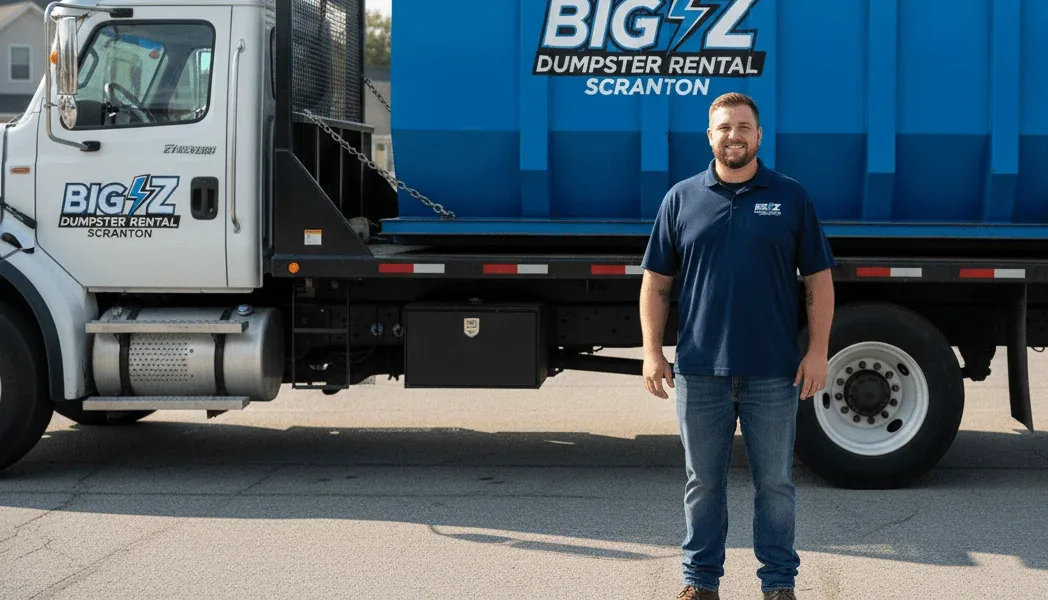
I get this question more than any other, and it usually comes out the same way: "Be honest with me — is that thing going to wreck my driveway?" Fair question. A loaded roll-off is one of the heaviest objects that will ever sit on your property, and in Scranton half the driveways I back into were poured before the Second World War. After 14 years of setting containers on Green Ridge concrete, Hill Section slopes and West Side alleys, here is the straight answer: damage is uncommon, it is almost always preventable, and the prevention takes four minutes of work with plywood before the can ever touches the ground.
What actually happens when the truck shows up
People picture a crane. It is nothing like that. A roll-off truck backs into position, the driver sets the brake and chocks, then hydraulics tilt the whole bed up on an angle. The container slides back on two steel wheels at its rear corners while a cable pays it out under control. Those wheels touch down first, roll a few feet, and then the container's long steel rails settle flat onto your surface as the bed comes down.
That sequence gives you exactly two pressure points, and they behave completely differently:
- The wheels, during the roll. Two small steel contact patches — think of the area of a coffee mug base each — carrying the container's weight while it is moving. This is the moment that gouges asphalt, chips a control joint or shifts a paver.
- The rails, while it sits loaded. Two steel runners the length of the box. The load spreads better here, but it sits for days or weeks, and weight only goes up as you fill it.
Pickup is the same movie in reverse, with one wrinkle: the container is heavy now. Which is why our drivers walk the drop before backing in — every residential delivery, no exceptions. We look at the slab, the joints, the slope, the wires overhead and where the water runs. More on how we work is on our about page.
The weight math nobody puts in the brochure
An empty 20 yard box weighs roughly two tons before you throw anything in it. Fill it with household clutter and you are at four or five. Fill it with shingles, plaster and lath, or a torn-out chimney and you can be at 8 to 10 tons or more — all of it on four small contact patches, not spread evenly like a parked car.
Material matters as much as size. A 20 yard container full of furniture is gentler on a slab than a 10 yard full of block. If you are throwing masonry, brick, dirt or asphalt chunks, tell us — that is a heavy debris job, and it changes both the size we bring and where we will put it. Our size guide for Scranton homeowners covers the rest.
What each surface can actually take
| Surface | Risk level | What we do | What you should do |
|---|---|---|---|
| Poured concrete, sound and 4"+ | Low | Boards under wheels and rails as standard; avoid stopping a wheel on a control joint | Point out any joint, patch or spalled area before we back in |
| Old or thin concrete, visible cracking | Moderate | Full plywood pad, load spread across the widest sound section | Consider street placement instead; expect us to say so |
| Asphalt (blacktop) | Moderate to high in summer | Morning drops, doubled boards under wheels, wide plank under rails | Do not schedule a hot-afternoon delivery in July or August |
| Pavers, brick, stamped concrete | High | Continuous plywood run; we will usually recommend somewhere else | Have an alternate spot ready — street, lawn edge or gravel pad |
| Gravel or stone | Moderate | Boards to spread the rails; we avoid drops within a day of heavy rain | Plan on raking and topping off the stone afterwards |
| Lawn or dirt | High when wet | Full board path for the wheels and rails; we may reschedule if saturated | Accept some rutting; mark the septic field, well and sprinkler heads |
Asphalt is the one that surprises people. Blacktop softens as it heats — on a 90 degree August afternoon the surface of a black driveway can run 140 degrees or higher, and a steel wheel will emboss it like a thumb in warm butter. That same driveway at 8 a.m. is firm. We schedule around it on purpose.
Pavers are the other one. They are strong individually but they float on sand, so a rolling steel wheel does not crack them — it shoves them sideways and ruts the bedding underneath. Once that base is disturbed, it stays disturbed.
The Scranton problems a generic guide will never mention
Most driveway articles online were written for a subdivision with a 30 foot wide driveway and no trees. That is not this city.
Shared driveways and double blocks
Half of Green Ridge, South Side and Minooka is double blocks with one shared driveway threading between two houses. Sometimes there is 9 feet between foundations and a container is 8 feet wide. That works, but only if the approach is straight and nobody's car is in the way — and it means talking to your neighbor first, because the box will sit partly in their sightline and possibly over the line.
Back alleys
Scranton's alley network is useful for placement and tight for a truck. The turning radius off a narrow alley is the limiting factor, not the alley width itself, and the service drops crossing those alleys hang lower than anything on the main street. We scout alley access before committing to it.
Hillside grades
The Hill Section, East Mountain and parts of the West Side have driveways steep enough that you feel it in your knees walking up. A roll-off on steel wheels sitting on a grade is a hazard, full stop. A container that starts moving on a slope does not stop until it hits something. We place across the slope or on the flat, or we go to the street. There is no third option worth the risk.
Aged sidewalks, curbs and street placement
The brick and old concrete sidewalks and curbing around the older neighborhoods crack under a loaded truck axle, not just under the container. Drivers pick their approach line with that in mind. And for row homes with no off-street parking — much of South Scranton, the flats, plenty of North Scranton — the street is the default, not the fallback. That means a right-of-way permit, cones and reflective marking, and paying attention to street sweeping and parking rules. We handle the logistics; read our Scranton permit guide and check the current requirements with the City of Scranton before you set a date.
Winter is the big one here
NEPA winters change every part of this. Frost heave lifts and cracks slabs, so a driveway that was flat in October is not flat in February. Ice under a steel wheel removes the friction that keeps a container where you put it — on any grade, that is how a can ends up in a garage door. Snowbanks eat the space you measured in the fall, and plow routes and snow emergency designations can make a street placement illegal overnight.
So yes, sometimes we will tell you to wait a day. If your driveway is sheet ice, the honest move is to salt it, let the sun work, and take the delivery tomorrow. That is not us being difficult — it is the difference between a clean job and a claim. Clear a path, pile snow away from the placement zone, and give us somewhere to actually set the box. Storm and flood work has its own timing problems, which we cover in our Lackawanna River cleanup guide.
Measuring your space
Rough numbers to check with a tape before booking:
- Footprint: a 10 or 15 yard runs about 12 to 16 feet long, a 20 yard about 22 feet, a 30 yard about 22 feet long and taller. All are roughly 8 feet wide.
- Approach: about 60 feet of straight, clear run for the truck to back in and roll off. Add the container length if you want the box positioned deep.
- Overhead: about 23 feet of vertical clearance for the hoist at full tilt. This is the one people forget.
That 23 feet is why overhead obstructions matter on older Scranton streets. Low service drops, mature maples and sycamores arching over the road, porch roof overhangs and garage-door trim all live in that zone. A driver will not tilt a bed into a wire, so a low drop can kill a placement outright.
What is under the surface
Buried hazards are a real category here because of the housing stock. Sewer laterals run shallow under older driveways. Old coal chutes and filled coal cellars sit under front walks all over this city and can void out beneath a slab. Buried oil tanks turn up regularly, and outlying townships have septic tanks and leach fields a 10 ton container will destroy. Add irrigation piping and invisible fence wire, neither of which is marked. Call PA One Call (811) before any digging, and tell us what you know is down there.
New concrete
Concrete reaches most of its design strength around 28 days, and it keeps curing well past that. A slab under about a month old should not take a loaded container at all. If you just poured, we will find you another spot. No exceptions on this one — I have seen what a fresh slab does under 8 tons.
Before the truck arrives
- Move every vehicle, trailer and basketball hoop out of the approach and placement zone.
- Mark the spot with a cone, a bucket or spray chalk, and text us a photo.
- Tell us about the septic, oil tank, sprinklers and the soft patch by the garage.
- Trim low branches you can reach safely; flag anything you cannot.
- Sweep or salt ice, and clear snow well beyond the footprint.
- Give the neighbor a heads up on a shared driveway.
Who is liable, honestly
Here is how the industry actually works, and any hauler who tells you different is selling something. When you direct a container to a specific spot on private property, you accept the normal surface wear that comes with the weight — light indentation on hot asphalt, settling in gravel, rutting on grass. Damage caused by driver error, such as backing into a porch column, clipping a garage or cracking a curb through carelessness, is on us. That is what licensed and insured means.
What a good hauler does is shrink the gray area in advance: boards down every time, a walked drop, an honest conversation when a surface is marginal, and a willingness to say "not there" or "not today." That is our standard on every residential rental, every roofing tear-off and every commercial job we run across Lackawanna County.
Call us and we will look at it first
If you are on the fence about your driveway, do not guess. Send a photo or ask for a site check — free, ten minutes. Mike or one of our drivers will tell you where the box should go, what goes under it, and whether the street is the smarter call. Reach us through the contact page or call Big Z Dumpster Rental Scranton at (570) 774-4910. Flat-rate pricing, protection boards standard, and a driver who walks it before he backs in.
Questions this guide did not answer? Call (570) 774-4910. We would rather spend two minutes on the phone than have you order the wrong container.