
Roofing
Roof Tear-Off Dumpster Sizing in Scranton: Get It Right the First Time
Squares, pitch multipliers and real tonnage numbers for Scranton tear-offs, including why original slate roofs need a small can and multiple hauls instead of one big container.
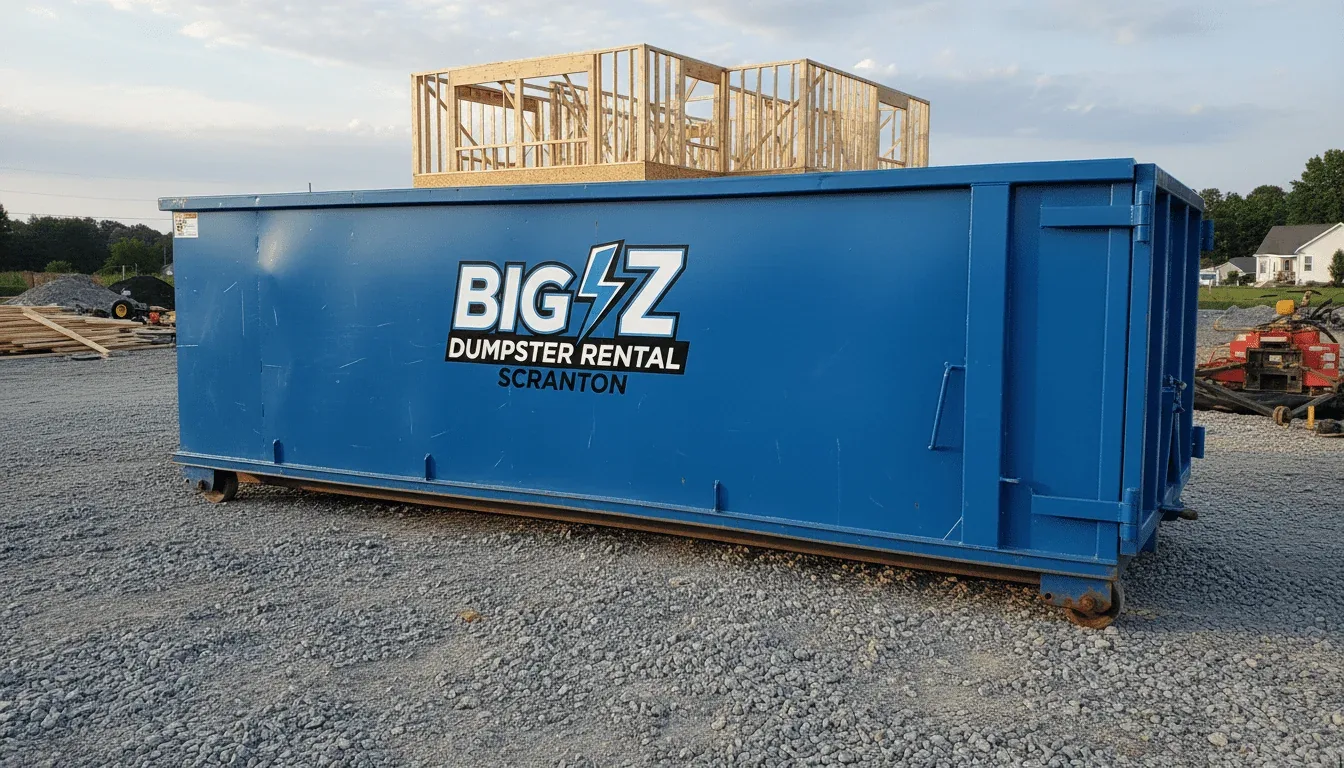
I have been pulling tear-off debris off Scranton roofs since before I ever owned a truck, and the single most common phone call I get in May runs like this: "I need a 30 yard for a roof." Nine times out of ten that is the wrong can. Roofing is the one job where the container that looks right is almost never the container that is right, because roofing debris is heavy long before it is bulky. Get the sizing wrong on a Green Ridge four-square and you are paying for overage, waiting on a second truck, or worse, staring at a container that legally cannot leave your street.
Here is how we size roofing dumpsters at Big Z, and why the answer in Scranton is different from the answer in a subdivision outside Harrisburg.
The Roofing Square: Your Only Real Unit
Roofers do not talk in square feet. A roofing square is 100 square feet of finished roof surface. Every estimate, every bundle count, every dumpster decision starts there. Three bundles of standard three-tab covers one square; architectural shingles usually run three to four bundles depending on the line.
To estimate squares yourself, start with the building footprint, not the roof. Measure the ground area under the roof, add overhangs, then multiply by a pitch factor — this is the step that catches homeowners out constantly around here. Scranton's pre-war housing stock is steep. A ranch at 4/12 is a rounding error; a Hill Section Victorian at 12/12 has close to a third more surface than its footprint suggests.
| Roof Pitch | Multiplier | Typical Scranton Example |
|---|---|---|
| 4/12 | 1.06 | Post-war ranch, Minooka |
| 6/12 | 1.12 | Cape Cod, South Side |
| 8/12 | 1.20 | Four-square, Green Ridge |
| 10/12 | 1.30 | Dunmore double block |
| 12/12 | 1.41 | Hill Section Victorian |
So a 1,400 sq ft footprint on an 8/12 four-square is not 14 squares. It is roughly 1,400 × 1.20 = 1,680 sq ft, call it 17 squares, plus dormers and a porch roof. That 20 percent is three squares of extra debris nobody budgeted for.
The Weight Math Nobody Runs Until It Is Too Late
Once you know squares, weight is straightforward arithmetic:
- Three-tab asphalt: roughly 220–250 lbs per square
- Architectural / dimensional asphalt: roughly 350–450 lbs per square
- Slate: roughly 700–1,000+ lbs per square depending on thickness and quarry
- Cedar shake: roughly 150–250 lbs per square (light, but bulky)
Run a normal Scranton job. Twenty-five squares of architectural at 400 lbs per square is 10,000 lbs — five tons before you have thrown a single nail in. Then add what always comes with it: felt or synthetic underlayment, drip edge, step and valley flashing, ridge vent, pipe boots, and the two or three sheets of rotten decking you find over the bathroom vent every single time. Budget another 10 to 15 percent on top of your shingle weight. That is standard, not pessimism.
The Slate Problem — The NEPA Special
This is the one that separates Scranton from most of the country. Anthracite money built these neighborhoods between 1890 and 1930, and a lot of those homes still wear their original slate — Pennsylvania Peach Bottom, Vermont grey, whatever the builder could get on a rail car. Beautiful roofs. Brutal debris.
At 700 to 1,000+ lbs per square, a modest 18-square slate tear-off is 6 to 9 tons. That is not a "roofing dumpster" question anymore, it is a heavy-debris question, and it gets handled the way we handle concrete and other dense material. Slate also does not compress or nest — it stacks flat, dense, and dead.
The rule for slate is counterintuitive but non-negotiable: use a small can and haul it more than once. A 10 yard loaded with slate hits legal axle weight when it looks about a third full. Put slate in a 20 or a 30 and you will build a container that no truck can lift off your street without breaking the law and the equipment. We schedule slate jobs as staged hauls from day one — can drops, crew fills to the marked line, we swap it the same afternoon. Tell us it is slate when you call and the whole plan changes for the better.
Multi-Layer Roofs: Multiply Everything
Pennsylvania code has long allowed a second layer over an existing one, and in a city this old you will find three regularly. The classic Scranton stack is original wood shake or slate, one asphalt overlay in the 1970s, another in the 1990s. Nobody knows it is there until the first square comes off.
Assume the worst if the house predates 1940 and the eave looks thick. Two layers doubles your tonnage. Two layers of architectural over original slate is a 20-square roof that weighs like a 45-square roof. If you cannot confirm layer count before delivery, size for the heavier case or plan on a swap — a mid-job swap costs far less than an overweight ticket. Our cost breakdown for Scranton lays out how flat-rate pricing and tonnage allowances actually work.
Sizing Rule of Thumb by Squares and Layers
| Roof | Squares | Est. Weight | Recommended Container |
|---|---|---|---|
| Single layer three-tab | Up to 15 | 1.5–2 tons | 10 or 15 yard |
| Single layer architectural | 15–25 | 3–5.5 tons | 15 yard |
| Single layer architectural | 25–35 | 5.5–8 tons | 20 yard |
| Two layers asphalt | 20–30 | 8–12 tons | 20 yard + swap |
| Three layers asphalt | Any | 12+ tons | 20 yard, staged hauls |
| Slate tear-off | 15–25 | 5–12+ tons | 10 yard, multiple hauls |
| Cedar shake | 20–30 | 2–4 tons | 20 yard (volume-driven) |
Notice what is missing. The 30 yard earns its keep on framing, siding, and whole-house cleanouts, but it is almost never the right roofing can. You reach the weight limit with the box two-thirds empty, and now you are paying for air you cannot use. The 15 yard and 20 yard do the overwhelming majority of residential tear-offs in this city, and they do it with a lower load height, which matters when your crew is pitching off an 8/12.
Placement on Scranton's Tight Lots
Half this city was platted before cars. Row homes on Cedar Avenue, double blocks in South Scranton, houses on Wyoming Avenue where the setback is eight feet — plenty of these properties have no usable driveway at all. That puts the container on the street, and street placement in the city means a right-of-way permit. We handle that conversation routinely; the mistake is discovering it the morning of the tear-off. Details on municipal requirements are available through the City of Scranton.
A few placement rules that save real money:
- Put the can on the tear-off side. A crew that pitches directly into the box works 30 to 40 percent faster than a crew carrying bundles around the house. On a double block, coordinate with the neighbor before delivery, not during.
- Use the back alley when it exists. Green Ridge and Dunmore have usable rear access on many blocks. Alley placement skips the permit and keeps the sidewalk clear.
- Protect the surface. Every Big Z delivery includes boards under the rails as standard — see how we protect driveways. Concrete curbs and older brick sidewalks crack under point loads, and August asphalt driveways go soft enough to dent.
- Leave 60 feet of clearance and 23 feet of vertical. Low utility lines and mature maples are the two things that turn a ten-minute drop into a rescheduled morning.
Weather Windows in Northeastern PA
Autumn is prime tear-off season here and every experienced roofer knows it: 55 to 70 degrees, shingles seal properly, and crews can work a full day. Summer is workable but the asphalt gets soft — shingles scuff under boots, and blacktop driveways mark up under container rails on a 90-degree afternoon. We schedule those drops early and board them heavily.
Winter is a scheduling headache, not an impossibility. Below about 40 degrees, shingles will not self-seal, adhesive strips need hand-nailing attention, and frozen debris in the can adds weight from ice and snow you paid nothing for and are still hauling. Emergency work happens — we deliver for it — but a discretionary tear-off booked in January costs more in labor and callbacks than one booked in October.
Storm, Ice Dam and Insurance Work
Wind events off the Moosic Mountains and the ice dams that build on north-facing eaves keep NEPA roofers busy every year. Insurance jobs have their own rhythm: adjuster inspection, scope approval, then a narrow window where the homeowner wants it done yesterday. We keep cans staged for that window, and if the damage runs past the roof into soaked insulation, ruined siding or downed limbs, the same container takes it.
What Rides Along, and What Absolutely Does Not
Goes in: shingles, slate, underlayment, drip edge, flashing, ridge vent, nails, plywood and plank decking, rotten fascia, torn-off gutters and downspouts, soffit, and skylight frames.
Stays out: partially full sealant and cement cans (liquids are prohibited), propane cylinders, torches, aerosols, and any suspected asbestos-containing material — old built-up roofing and some 1950s-era felts qualify and require licensed abatement under PA DEP rules. Our full Lackawanna County disposal list spells it out.
Swap-Outs and the Magnet
On slate and multi-layer jobs, plan the swap into the schedule rather than calling for it in a panic at 2 p.m. Tell us the load line — most crews mark it at the top of the side rail — and we will have a truck rolling. Then finish the job right: roll a magnet across the lawn, driveway, sidewalk and street margin, twice, in perpendicular passes. Tear-off nails end up in tires and bare feet for years otherwise.
Contractors: Get on the Book
Most of the roofing crews we serve in Lackawanna County run standing accounts — they text a size and an address the day before and the can is there before the ladders come off the rack. Next-morning delivery, flat-rate pricing with no surprise fuel add-ons, and a driver who knows what a 10/12 pitch means for placement. Mike Zaleski has been doing this locally since 2011, and the whole operation is built around crews that need to start at 7 a.m., not 10.
Sizing a tear-off is not guesswork once you know your squares, your layers, and your material. Call Big Z Dumpster Rental at (570) 774-4910, tell us the roof and the neighborhood, and we will tell you exactly what to put in front of the house — or reach us through our contact page and we will get back to you the same day.
Questions this guide did not answer? Call (570) 774-4910. We would rather spend two minutes on the phone than have you order the wrong container.